
Tuesday, November 29, 2022
A moment of peace
Here's why the Creative Commons license is a wonderful thing: a photograph of mine on Flickr showing a Bangalore street with a Hindu temple and Muslim mosque in close proximity was used to illustrate a post on Indian Muslims Blog calling for peaceful dialogue between Hindus and Muslims.
Thursday, October 17, 2013
My story 'Instrument' released in a new fiction anthology
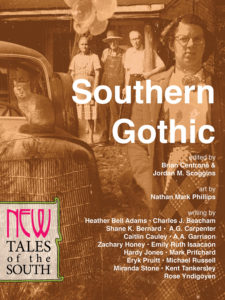
A new fiction anthology from New Lit Salon Press entitled Southern Gothic has just been released, and it contains a short story of mine entitled "Instrument."
The genesis of the story is this. In the mid-to-late 1990s, a phenomenon began at a Toronto area Pentecostal church called the Toronto Airport Vineyard. (Much as this sounds like an airport hotel, it was simply a branch of the Vineyard Fellowship of Pentecostal churches with an unusually anodyne name.) The phenomenon was marked by an outbreak of seemingly out-of-control emotional outbursts. The phenomenon came to be known as "the laughing revival" because one of the behaviors on the part of church attendees was uncontrolled laughter or crying. It lasted for years and spread to many other Pentecostal and charismatic churches.
I developed a morbid fascination with the phenomenon, which also took root in Brownsville Assembly of God in Pensacola, Florida. I was fascinated by the stories of wild behavior and the claims that the Holy Spirit was behind it all, when a distanced observer could clearly see it was nothing more than mass hysteria.
Despite my personal disdain for this brand of religion, I sensed that sincere people were flocking to such churches for a reason. They wanted not only experience, emotion, and entertainment, but also something genuine. They wanted what the revivalists were promising: not just an overflow of emotion, but to be truly changed.
With this in mind, I developed a story about someone who came to such a church out of curiosity. He's not a true believer, but a skeptic, a not-particularly-religious young man who looks at spirit-filled Christians not with envy but with pity. Nevertheless, he finds himself at one of these revivals, and is tempted by the offer of a truly changed life.
My character Roy is assistant manager of a Chevron station. But he has a secret wish: to become an EMT, an ambulance attendant. And when he attends the revival he is caught up in the experience and dares to think that despite his doubts his life might really change.
Southern Gothic, with my story and 14 others, is available now in many e-book formats, handsomely illustrated by Nathan Mark Philips.
Thursday, July 25, 2013
The first sentences of Stephen King
The author Stephen King "spends 'months and even years' writing opening sentences" for his books, according to this article on The Atlantic.
Maybe so! Here are the first sentences from 35 of his books. Judge for yourself.
"Jack Torrance thought: Officious little prick."
-- The Shining
During the days after they left the Green Palace that wasn't Oz after all -- but which was now the tomb of the unpleasant fellow Roland's ka-tet had known as the Tick-Tock Man -- the boy Jake began to range farther and farther ahead of Roland, Eddie and Susannah.
-- The Wind Through the Keyhole
An old blue Ford pulled into the guarded parking lot that morning, looking like a small, tired dog after a hard run.
-- The Long Walk
The terror, which would not end for another twenty-eight years -- if it ever did end -- began, so far as I know or can tell, with a boat made from a sheet of newspaper floating down a gutter swollen with rain.
-- It
Hapscomb's Texaco sat on Number 93 just north of Arnette, a pissant four-street burg about 110 miles from Houston.
-- The Stand
To Whom It May Concern: My name is Wilfred Leland James, and this is my confession.
-- Full Dark, No Stars
He kept doing things without letting himself think about them.
-- Roadwork
Almost everyone thought the man and the boy were father and son.
-- Salem's Lot
News item from the Westover (Me.) weekly Enterprise, August 19, 1966: RAIN OF STONES REPORTED
-- Carrie
There's a guy like me in every state and federal prison in America, I guess -- I'm the guy who can get it for you.
-- Different Seasons
My name is Edgar Freemantle.
-- Duma Key
Once, in a kingdom called Delain, there was a King with two sons.
--The Eyes of the Dragon
Umber whunnn / yerrrnnn umber whunnn / fayunnnn / These sounds: even in the haze.
-- Misery
"Oh! Oh, Jesus! Gross!"
-- Desperation
The event that came to be known as The Pulse began at 3:30 p.m., eastern standard time [sic], on the afternoon of October 1.
-- Cell
The world had teeth and it could bite you with them anytime it wanted.
-- The Girl Who Loved Tom Gordon
"Oh my God!" my friend Arnie Cunningham cried out suddenly.
-- Christine
The two things Sarah remembered about that night later were his run of luck at the Wheel of Fortune and the mask.
-- The Dead Zone
George was somewhere in the dark.
-- Blaze
She was squinting at the thermometer in the white light coming through the window.
-- The Running Man
Louis Creed, who had lost his father at three and who had never known a grandfather, never expected to find a father as he entered his middle age, but that was exactly what happened.
-- Pet Sematary
It was fourteen years of hell, all told, but she hardly knew it.
-- Rose Madder
"Daddy, I'm tired," the little girl in the red pants and the green blouse said fretfully.
-- Firestarter
Once upon a time, not so long ago, a monster came to the small town of Castle Rock, Maine.
-- Cujo
From the East Oregonian, June 25th, 1947 -- FIRE CONTROL OFFICER SPOTS 'FLYING SAUCERS'
-- Dreamcatcher
Dear Bones, How good it was to step into the cold, draughty hall here at Chapelwaite, every bone in an ache from that abominable coach, in need of instant relief from my distended bladder -- and to see a letter addressed in your own inimitable scrawl propped on the obscene little cherry-wood table beside the door!
-- Night Shift
On a very hot day in August of 1994, my wife told me she was going down to the Derry Rite Aid to pick up a refill on her sinus medicine prescription -- this is stuff you can buy over the counter these days, I believe.
-- Bag of Bones
Bobby Garfield's father had been one of those fellows who start losing their hair in their twenties and are completely bald by the age of forty-five or so.
-- Hearts in Atlantis
To the public eye, the spouses of well-known writers are all but invisible, and no one knew it better than Lisey Landon.
-- Lisey's Story
People's lives -- their real lives, as opposed to their simple physical existences -- begin at different times.
-- The Dark Half
Jessie could hear the back door banging lightly, randomly, in the October breeze blowing around the house.
-- Gerald's Game
For want of a nail the kingdom was lost -- that's how the catechism goes when you boil it down.
-- The Tommyknockers
Brian Engle rolled the American Pride L1011 to a stop at Gate 22 and flicked off the FASTEN SEATBELT light at exactly 10:14 p.m.
-- The Langoliers
"Thinner," the old Gypsy man with the rotting nose whispers to William Halleck as Halleck and his wife, Heidi, came out of the courthouse.
-- Thinner
What did you ask, Andy Bissette?
-- Dolores Claiborne
Monday, June 17, 2013
Watching over her
Here's a picture of Cris and me on the porch of the rented house in Kansas City, Kan. the night before we flew back to San Francisco.

Mid-April, 2013. Photo by Jeff Barber
It had been a cold, rainy week, but this last day was sunny. As the sun set, I glanced out the window and said, "Oh, the sun's reflecting off the skyline." So we all went out and took pictures. At one point Jeff took this picture of me and her.
Saturday, June 08, 2013
Six months less six weeks
Yesterday Cris was uncomfortable all day with nausea. At 6:00 pm she asked me to google some search terms, and based on the results she decided to ask the doctor for some specific anti-nausea medicine. She reached the doctor's backup and he agreed to phone the pharmacy with the new scrips. About this time, Catherine came over. We didn't really have plans, but she wanted to eat. So after she spent 15 minutes talking with Cris, she and I walked over to Mission Street. My idea was to pick up the scrips and then take them along with us to dinner. So far so good.
But the pharmacy didn't have Tigan in stock, and neither did any of the other nearby Walgreens. So I had to call Cris to report this. She said she would call the doctor back and try to get an alternate. Meanwhile I figured Cath and I would have time to go eat and return to the pharmacy in time to pick up the revised order.
As we walked down Mission on the way to the restaurant, I went into a small rant. "This is so typical," I said. "Cris is the one to recognize that she needs a new med, Cris is the one to call the doctor, and when that doesn't work, Cris is the one to call him back." My voice was breaking now. "She's always the one who manages her own care. She's the one to call. I don't know how to do these things. Who's going to do that when she's unconscious?"
Catherine put her arm around me. "When she's unconscious... She'll have different needs. That's not a long period anyway. If she's at the point where she's in a coma, you just take care of the body. It only last a few days. I know, this is so hard."
I managed not to break down in tears.
Saturday, May 11, 2013
The trees from my wife

This picture is our garden this morning. Much of the foliage is made up of two medium-sized ornamental cherry trees, though at the top you see a grapevine and in the lower right corner is wisteria. I took the picture from the window of the room in the rear of the house, a bedroom converted to an office.
The cherry trees were a gift from my wife for my birthday several years ago, soon after we moved into the house in the mid 1990s. The one on the left is original; the one on the right is I think the third one we planted there; two previous ones didn't survive. Now the trees are almost the same size, though one is four years older than the other. They have very different personalities, the chief difference being that the older one always blooms first and more completely.
Here they are last spring:

Right after I took the picture this morning, while I was shutting the window, a big robin zoomed in and landed in the tree on the right, and I felt joy at the thought of the creature taking up residence here.
Wednesday, March 06, 2013
Uncertainty principle
In a dream: A woman who was an oracle or priestess of some kind was the guardian of a portal that was located in a cavern. The portal was a small vertical hole, only a few inches across, and you looked into it with an instrument like a microscope. When you looked into this portal you were looking into what was supposedly a microscopic world, only it appeared to be a whole universe, like the pictures from the Hubble. In other words, this microscopic world contained the whole universe, and you could look into it and see whatever you wanted to in space-time. Thus the guardian was a powerful oracle, though she was not the only one allowed to look into the microscope, indeed anyone who came to her could look into it, and she helped them.
I asked her, "Is it perfect?" meaning the universe contained in the portal. And she replied, "As long as we're here (to look at it), we change it."
Tuesday, February 05, 2013
Farce alert
A good friend, who writes under the name Amber Belldene, linked to a fellow writer's blog post about a recent release. The blog post is headed Where to Dump a Body in Austin. This immediately made me think, wow, there are a zillion places for that.
But my second thought was -- based on my visit to Austin in the fall -- that would get me in trouble right away. Because as my recent trip demonstrated, while I used to be intimately familiar with Austin, that town has changed a lot in 30 years, and if I tried to do anything there -- never mind dumping a body, how about getting a sandwich -- I'd quickly get in trouble.
So this scene suggested itself: Suppose someone like me who used to live in a place claims to be an expert on that place. And a friend comes to him asking to dump a body. No problem! But when they get to the first place, which in 1978 was a garbage-strewn ravine, it's now the grounds of a day care center outside a corporate complex. And when they get to the second place, which in 1979 was an abandoned rail line, it's now a nicely landscaped bike path. And so on. Finally they dump the body on the steps of the governor's mansion, which in Texas is always a place where you'll find garbage and plenty of skeletons in the closet.
Monday, February 04, 2013
Another search for authenticity ends in disappointment
A travel piece in the New York Times last week goes to a remote Indian town founded by Nobel Prize-winning poet Rabinidrath Tagore. After visiting the school founded by the sage, a museum devoted to his work (from which his Nobel Prize medal was stolen in 2004), and other local sites, the visitor encounters local color:
Toward the end of my stay, I encountered a baul singer alongside the road, strumming an ektara, a guitarlike instrument with a single string. He waved and I steered my bike toward him. With their unruly hair, matted beards and saffron kurtas, the singers (baul means "crazy") are difficult to miss. Neither Hindu nor Muslim, they are said to be insane with the love of God and wander the countryside, as they have for centuries, singing enigmatic songs about the blessings of madness and the life of a seeker. Tagore adored the bauls, and even declared himself one of them.I sat on the ground and listened to the hypnotic music. Bauls have grown popular in recent years and, inevitably, poseurs have tried to cash in. So when another traveler, a well-off Kolkatan with an expensive camera, joined us, I asked, "Do you think he is a real baul singer?"
Clearly displeased with my question, he said after a long pause, "He's as real as you want him to be."
Tuesday, January 29, 2013
Underground for years
The following exchange was broadcast a little while ago on the BBC News Hour. The announcer, Owen Bennett-Jones, was interviewing former British Ambassador to North Korea John Everard about life in that country. At one point they reference the Google Maps of North Korea, which were just released.
Everard: You could travel freely within thirty km of central Pyongyang, which gave you the city itself and a lot of countryside. If you went outside that, the rule book said that you require permission. In practice, you could go to the beach at Nampo, heading due west from Pyongyang, and no one would actually stop you. And colleagues did the same on the beach going the other way, at Wonsan (?), going east. And on one occasion I drove about two thirds of the way up to the Chinese border to see a museum there, which I duly did, and no one seemed to (care) that I'd gone way outside Pyongyang.
ANNCR: No permission?
Everard: No permission. So the system isn't quite as watertight as people make out.
ANNCR: One of the striking things about the [just-released] Google Maps -- I don't know if it surprises you -- they've marked one of the labor camps.
Everard: Yes, so I saw. The position of the labor camps has been argued over for quite some time. And things are complicated by the fact that -- we believe -- that some of the labor camps are actually underground, so they won't show on maps.
ANNCR: Really?!
Everard: Yes.
ANNCR: Why?
Everard: Well, because, if you put a labor camp underground -- remember that these are slave laborers, often making munitions and things that the regime doesn't want to show the world. If you put them underground, you can't actually spot them from satellites, or it's a lot more difficult to do so. A colleague of mine once gained access, incredibly, to one of these places. And told me that he found that the people there had been underground for years, hadn't seen the light.
ANNCR: How on earth did a foreigner get in there?
Everard: It's a long story.
ANNCR: Which you can't tell?
Everard: Which I can't tell.
-- BBC News Hour, 2145h GMT, 29 January 2013
Everard is the author of a memoir about his time in North Korea, Only Beautiful Please.
Wednesday, January 23, 2013
Screenwriting columnist confirms that screenwriting is nothing but arranging clichés
Whenever I read about the screenwriting game, it always sounds to me like it's nothing more than understanding clichés as fully as possible so that they can be rearranged in such a way that's just barely different from the last time they were successfully rearranged. And nothing in the first paragraph of this fellow's column changes my mind:
Even a hero sometimes needs a push out of the front door and into the arms of adventure. Your detective needs to get himself embroiled in that mystery; your crude-humored man-child needs a reason to get a job so that the "fish out of water" hilarity can ensue; and how about your plucky secretary who is down on her luck but has a heart of gold? Well, she needs that spark to help her decide it's finally time to take her career into her own hands.
Ugh. It's worse than boring. It's demeaning.
Sunday, January 20, 2013
'Well this is arty'
I was reading a post about the film TAXI DRIVER on a cinema website and had gotten to the comments; in fact I made a comment of my own. I was about to click off the page when I noticed one of the comments seemed a bit odd, coming from someone with the name Prague Taxi Transfers:

So the taxi service in Prague was "very impressed," was it? Curious, I clicked on the name of the account, and up popped a whole series of comments made by the same account using a Disqus login. Each anodyne comment was made on a post with the word "taxi" or "cab" in its title -- 29 of them! And yet the comments have nothing to do with taxis at all. They could appear on almost any post.
Of course, what's happening is that a robot is leaving these on any blog post that has remotely to do with taxis, for the purpose of search engine optimization. The more web pages that link back to the site of Prague Taxi Transfers, the higher they appear in Google search results -- or at least that is the aim.
Taken together, the comments form a one-sided dialogue that make you feel like you're overhearing someone's gossipy phone conversation.I have had the same thing happen to me.
It really made my day.
Well nothing amazes me.
This was very emotional.
Yes I did and thought it was shocking!
I do think it is something that deserves more media attention.
Friday, January 18, 2013
Sounds like a business idea to me
This tweet crossed my Twitter feed. I don't know the originator, but as you can see it was retweeted by SFMOMA:

SFMOMA, this seems like a business idea to me. Why not have a bullpen of MFAs eager to accompany visitors to your museum? They could make a few bucks and you could too.
Thursday, January 17, 2013
The fictional world
With all the schadenfreude I can muster, I enjoy the uncovering of hoaxes and frauds. And the last week has been an exhausting carnival of revelations. A famed college football player's heartwarming story of a girlfriend who died; a prize winning poet; a cycling champion; and baseball Hall of Fame voters rejected the stars of the late 90s and early 00s. It's getting difficult to keep up, but Twitter and Gawker and the like are always there to spread the latest.
Also via the internet come these words of advice on writing from novelist W.G. Sebald:
You should ask other people for information, and steal ruthlessly from what they provide. None of the things you make up will be as hair-raising as the things people tell you.
It's both reassuring and not. You'll never run out of ideas, but those ideas will be rooted in the depressing plenitude of human weakness.
Imagine a story, then, about a protagonist who invents a lover, or mentor, or literary agent, or other close partner or adviser. Someone who is close to them, who provides invaluable support, and who is, for plausible reasons, not available in person -- not now and, as it turns out, not ever. Call the imaginary person Aubrey Daniels, just to use a gender-neutral first name, and name the story "The Fiction of Aubrey Daniels," which makes ironic use of the humble word of. The story is more about the weaving of the fiction, and the uses to which the protagonist puts the fictional Aubrey, though of course the story has to include the uncovering of the hoax and the reaction of all the people who were fooled by it.
(To be fooled is to be made into a fool, an interesting grammatical construction I don't know the name of and can't think of another example of, aside from the newish term to punk someone, which means almost the same thing. Perhaps this usage is related to the joke "Call me a cab." "All right -- you're a cab." I hope a rhetorician can clear this up for me.)
Wednesday, January 16, 2013
Without music or media
I've been living in complete silence for months, I might say for years, with just the usual dull sounds you hear at the outskirts of town, the occasional echo of steps in the corridor and, further off, in the stairwell, someone dragging a sack, a carpet, a package, or a corpse, God knows what, along the ground; or the sound of the elevator as it slows, stops, opens, then closes and starts to rise or descend. Every so often a dog barks briefly, someone laughs or shouts. But everything dies away, soon lost in the constant low-level murmur of the street outside. That is what complete silence is like round here.
-- László Krasznahorkai in the New York Times blog
Of course, everyone in the world lived that way before the advent of the photograph and radio, the television, the home stereo system, piped-in Muzak, the "personal" media player, and so on.
Several years ago I spent six weeks in a remote mountain retreat. My mornings were spent in the kitchen, where music played all the time and made the time pass pleasantly. After that I enjoyed silence, solitude and time to work -- for a week. Then a young man moved in upstairs and blared his stereo. It took me several negotiations to get him to let me have, at least, the afternoons to work in silence. But the irony was that I had to negotiate silence at all in a remote mountain retreat.
Like time and space, the commodity of silence becomes more and more valuable -- especially as you get older.
Tuesday, January 15, 2013
From a dream
Fragment of an otherwise unremembered dream from Sunday night which I wrote in the bedside notebook when I woke:
The suffering would be immediate and actual, which was not to be desired, unless you compared it to...
Monday, January 14, 2013
'Readers don't care about the writer and are distracted instead by small things like their own lives'
Loved this.
Personal writing should entertain the reader. (And by this I do not mean the voyeuristic train wreck entertainment that one gets from reading, say, Naomi Wolf's account of losing the Technicolor Wizard of Oz–like effects of her orgasms. It should be deliberately entertaining, not accidentally funny.) Most readers don't care about the writer and are distracted instead by small things like their own lives, and so it is incumbent upon the writer to make them care or draw them in by being fascinating or funny or unusually observant.
Carried to extremes, this attitude might be expressed with a degree of hostility:
It turned out a couple of students had complained to the chair about my comments on their stories. He showed me a page with red slashed across: "Who cares? I don't care! Make me care!"
"What did you mean by this?" he asked.
"Simply that a narrative is worthless unless the reader can be made to care about the characters and what happens to them," I said, as simply as I could.
"You were trying to tell the student that her story is worthless?"
"In its present form, it is worthless."
Sunday, January 13, 2013
Mu
The film segment The Heavenly Creature -- one-third of an anthology film titled "Doomsday Book," from three South Korean filmmakers -- is
... a lyrical and philosophical anecdote about a robot who works in a Buddhist monastery. The monks believe the machine has achieved enlightenment, and this presents a problem for the robot's corporation. Is it malfunctioning? Should it be destroyed? What does "existence" mean anyway for an enlightened one? This is like a koan, an excuse for dialectics between characters who assert opposing views, something to be puzzled over more than a narrative to be resolved.
-- Pop Matters
The monks believe the machine has achieved enlightenment. How could monks be that stupid? Clearly this is simply a comic premise. This presents a problem for the robot's corporation. Is it malfunctioning? A robot in a monastery which appears enlightened must be the best robot ever; how could anyone think it was malfunctioning? What does "existence" mean anyway for an enlightened one? Enlightened or unenlightened, there is no choice between existence or non-existence. He (or that) which does not exist can be neither enlightened nor unenlightened. This is like a koan. You think?
Wednesday, January 09, 2013
The frightening internet
Because my employer urged me to -- it seems we are all being urged to "connect with customers" over social media, not that I have any intention of doing so (I'm sure they would be the worse for it) -- I finally joined a social network called LinkedIn. And as soon as you join, they ask permission to slurp up your contacts list. No, I replied, skip it. And yet even though I had denied them the right to know my email contacts, they proceeded to present me with about 200 people who might know me. And damned if about 40% of them weren't accurate.
How the hell did that happen, I wondered. How did they get the name of someone who contributed to Frighten the Horses, the sex-and-politics zine Cris and I did over 20 years ago -- an era before email and the internet -- and whom I've corresponded through email exactly once since then? It was fucking eerie.
This blog entry helped me understand. Both the entry itself and, especially, the fourth comment, which points out that those people are already on LinkedIn and they did share their email contacts list. So that artist who did the piercing layout for us in 1992 was actually on LinkedIn before me, and shared my email address, so when I popped up, there she was as one of the people I possibly knew.
I was glad that I recognized only 40% of those 200 people (which is still a lot). Because that means that 60% of them know some other Mark Pritchard. And they can have him.
Thursday, January 03, 2013
This America
Driving in the South of Market district this morning, I stopped at a traffic signal. I'd just been to the supermarket and then to a coffee bar and was on my way to a freeway onramp to come to work. I noticed a pedestrian in the crosswalk. He was a young man, no more than 25, and a little overweight. He had a shambling gait and was making weird motions, digging the knuckles of one hand into his cheek and jaw as if tightening invisible bolts; with each second that I watched him, as he slowly made his way across wide Bryant Street, I was more convinced that he was mentally ill. He wore a light jacket, not enough for the cold morning. But what struck me most was that, with the temperature about 42 F., he was barefoot.
One sees mentally ill people on the streets of every American city. The only thing that distinguished this guy was his youth and appearance. He wasn't dirty or unshaven; except for his shoelessness, he might have taken off that morning from whatever home or facility he lived in, a place where his clothes were washed and he was well fed. But his gait and general behavior revealed his illness.
I felt compassion, and thought of actually stopping and giving him my shoes and socks. I have hiking boots in my car which I could have put on, and a spare pair of socks at work. But I did nothing.
"What is hell?" asked Dostoyevsky in The Brothers Karamozov. "I maintain that it is the suffering of being unable to love."
Wednesday, January 02, 2013
Entanglement between evangelical churches and adoption industry
I've been hoping someone would look into this story for ages, ever since my fundie brother adopted two kids over 15 years ago and spoke of it as something many people in his acquaintance were doing. I knew somebody had to be making money. Finally there's a book:
The Child Catchers: Rescue, Trafficking, and the New Gospel of Adoption
by Kathryn JoycePublication Date: April 23, 2013
Adoption has long been enmeshed in the politics of abortion. But as award-winning journalist Kathryn Joyce makes clear in The Child Catchers, adoption has lately become entangled in the conservative Christian agenda. To tens of millions of evangelicals, adoption has become a new front in the culture wars: a test of "pro-life" bonafides, a way to reinvent compassionate conservatism on the global stage, and a means to fulfill the “Great Commission” mandate that Christians evangelize the nations. Influential leaders fervently promote a new "orphan theology," urging followers to adopt en masse, with little thought for the families these "orphans" may actually have. Christian adoption activists have added moral weight to a multi-billion dollar adoption industry intent on increasing the "supply" of adoptable children, both at home and overseas.The Child Catchers is a shocking exposé of what the adoption industry has become and how it got there, told through deep investigative reporting and the heartbreaking stories of individuals who found that their own, and their children's, well-being was ultimately irrelevant in a market driven by profit and now, pulpit command.
Kathryn Joyce is a journalist based in New York City whose work has appeared in the Nation, Mother Jones, Slate, the Atlantic, and other publications. A 2011 recipient of the Knight Luce Fellowship for Reporting on Global Religion, she has also been awarded residencies and fellowship support by the Nation Institute Investigative Fund, the MacDowell Colony, the Bellagio Center, and the Pulitzer Center for Crisis Reporting. She is the author of Quiverfull: Inside the Christian Patriarchy Movement and associate editor at Religion Dispatches.
Tuesday, January 01, 2013
Infra-noise leads to ghost reports
And then there is sound we can't hear — infrasonic. In 1998, a group of scientists working in a laboratory began to feel as if they were in a haunted house: They thought they saw blurry gray figures and were full of dread, a science journal reported. They finally traced the effect to an extractor fan, whose infrasonic noise happened to be "at just the right frequency to make eyeballs vibrate and so perhaps to generate visual illusions."
-- from a review in today's NYT by Katherine Bouton of
Discord: the Study of Noise, by Mike Goldsmith
Saturday, December 22, 2012
Amateur philologist 'through the looking glass'
The current New Yorker has a fascinating and moving article by Joshua Foer about an amateur philologist named John Quijada. This middle-aged employee of the California Department of Motor Vehicles devoted his life to the creation of a language which contains the most distinctive features of other world languages, from the most common to the most obscure, in an attempt to create a more perfect language. The invented language, which he called Ithkuil, attempts to express concepts in a compacted fashion, so that, for example, a single word can express "that chin-stroking moment you get, often accompanied by a frown on your face, when someone expresses an idea that you've never thought of and you have a moment of suddenly seeing possibilities you never saw before."
The article, "Utopian for Beginners," develops like the usual wooly New Yorker article, taking as much time as is necessary to explain who Quijada is, why he grew interested as a youth in invented languages, and what he achieved with Ithkuil. But it is when he learns that his invented language, which he had published on the internet, had been taken up by a group of intellectual Russians and other post-Soviets, that the story suddenly becomes like a Bolaño novel.
Quijada is invited to attend a conference in an obscure corner of the forgotten USSR and finds that he is considered a hero by young students who are using his language in a discipline called psychonetics. Psychonetics turns out to be one of those quasi-mystical, quasi-scientific fields that Russians and other former Soviets tend to foster -- an allegedly scientific approach to changing how people think.
Quijada once hoped to become an academic, a professional linguist, but simply couldn't afford to go to grad school, and instead became a bureaucrat in a state agency. Now, still slightly mystified by his hosts' goals, he basks in the attention of scholars:
As the evening unfolded, he found himself perched barefoot and cross-legged on a sofa, with a group of young Russian students gathered on the rug at his feet.
"I was surrounded by all these people hanging on my every word. It was intoxicating -- especially for a loner like me," Quijada said. "For one day, I got to play as an academic. I got to live this fantasy where I took the other path in the garden. I got to see what it would have been like if I had gone to graduate school and become a professional linguist. The fates of the universe tore open a window to show me what my life could have been. That night, I went back to my room, took a shower, and burst into tears."
You'd think that this would be enough of a poetic ending to Quijada's story. But it's after this that things start to get weird.
Invited to another conference the next year, he gains an insight into what these "psychonetics" enthusiasts are really about. It turns out that one of the primary supporters of psychonetics is an ultra-nationalist who "talks of developing 'intellectual special forces' that can bring about the 'reëstablishment of a great power' in greater Russia, and give birth to a 'new race... that can really be called superhuman.'" It seems the psychoneticists want to use Quijada's "more perfect" language as a tool.
Appalled by their goals, Quijada withdraws from any further participation in post-Soviet psychonetics, and the article's author draws the usual wan New Yorker-ish conclusion that Quijada isn't the first person to invent a language and see it being used for means he never intended.
But I was impressed by the story's Bolaño-ish theme: How the actions of well-meaning people are adopted by a fascist movement, and the temptation this represents for ordinary people.
Friday, December 14, 2012
Oh, a media frenzy
Earlier this week, news media in northern California and Oregon especially were focusing on the aftermath of a mall shooting in suburban Portland, Ore. Driving through Oregon yesterday I heard some discussion about it, gathering the interesting fact (if it is a fact and not just something the reporter made up) that suburban Clackamas County is referred to locally as "Clackistan" and its denizens as "Clackistanis."
Three people including "the shooter" (and when did mainstream media begin using that term anyway, and did it come from Hollywood, from the military, from video games, or what?) died in that event, which seemed bad enough until today, when over two dozen died in a school shooting in Connecticut.
Mainstream media pushed the big red button that reads "Wall To Wall Coverage," so during my drive through eastern Oregon and over the Idaho border I heard "breaking news coverage" on NPR. And I listened to all of it, when they finally took a break and ran "Fresh Air" for an hour.
I asked myself, why listen to all that coverage which lasted, what, over three hours? I think the reason is, for once it's not drivel. Not that NPR is relatively high on the scale of broadcast drivel, which was epitomized for me this morning when I turned on the "Today" show while packing in my motel room. The hosts sat around chattering and "joking" without humor and laughing anyway, in that awful way straight people do when they have nothing to talk about but social time to fill.
So when the hours-long coverage of the school shooting came on today, it was actually a relief. Finally, something actually happened. Finally, people have stopped bullshitting for hours on end.
Of course that only lasts so long. I remember the moment on Sep. 11, 2001 when the incident had started to sink in. The moment was the point during the afternoon when, on network and cable news, the coverage acquired branding (recall the graphics reading "ATTACK ON AMERICA" and so on) and theme music which led onto and out of each news segment. And when they start the slow-mo, soft-focus montage of teddy-bear memorials, that's when you know it's really over.
At the moment I'm sitting in a McDonald's in Mountain Home, Idaho, where my order of a salad from the menu so flummoxed them that they took 10 minutes to prepare it and gave me a fried apple pie for free by way of apology. (The wi-fi works here, hooray.) They have a TV on the wall playing Fox News, where Mike Huckabee just assured gun owners that "You can't legislate prevention of events like this" because "this is not a law issue, it's a heart issue." I doubt very much he feels that way about abortion or drugs, but at least they are not showing teddy bears yet.
Thursday, December 13, 2012
Another road trip
On my way from San Francisco to Pocatello, where I'm heading to visit a friend who teaches at the university there, I stopped in Weed last night (A) and in Burns, Ore. tonight (C):

Based on previous experience, I knew not to expect 3G service for my smartphone inbetween towns, but I thought there was a chance at my destination. No, not with Virgin Mobile. Good as their coverage is in metro areas, this is not in anyone's metro area. Problem: I forgot which motel I had reserved at, and I needed to check my email for the reservation. So I needed wi-fi somewhere. Usually a McDonald's is good for it, but when I stopped a the one here, it wasn't working right.
I noticed a small bookstore-gift shop on the main street, and I went in to ask them where I might find wi-fi. They had free wi-fi, bless them! And they sell espresso, too. It was a little late in the afternoon for me to have a cappuccino, but I bought a book. Stop by the Book Nook when you're in Burns, Oregon.
Okay, but the drive. For many years I've wanted to check out the northeast corner of California, because it's such a mystery. It's not on the way to anywhere; there is no reason ever to go there, unless maybe you're a hunter or fisherman, or you're driving from, say, Weed, California to southern Idaho.
Several times I'd driven through part of this country on US 97 just south of the California border, where it passes through a strange "national grassland" -- the only one so obscure it as "NO WEBSITE":

So if the grassland was so obscure, you can only imagine how curious I was about the part of California east of that. Well, it's high desert -- which means there is almost nothing out there but sagebrush, with the occasional smattering of pine trees in certain advantageous places. But the amazing thing about the drive is that there is nothing else out there. No shacks, no trailers, no ranches, no electric poles, no cell phone service, no billboards. I drove 30 miles before I even saw a sign reassuring me I was on a US highway. And the part in Oregon is, if anything, even more desolate.
It's a real change from the southern California desert which I've visited so often. There it's difficult to find truly empty vistas. There's always a railroad or a microwave tower or a power pylon or some abandoned shack in the picture.
Zero time taking pictures, unfortunately. For part of the drive the shoulders were snow-covered, though almost no snow fell on me. Been lucky with the snow so far.
Monday, December 10, 2012
Facing yet another extended drought, Texas wakes up to water shortages
There is no doubt that Texas is in dire need of a well-funded water plan, and lawmakers on both Republicans and Democrats appear ready to do something this year. Part of the impetus comes from experiencing the worst single-year drought in Texas history in 2011. The rest comes from the realization Texas isn't ready for the next one. ...
Next year lawmakers will hear from a number of constituents with competing interests on water. Timber companies don't want any more East Texas land flooded, many high-tech companies need water for new plants, ranchers don't want pipelines cutting across their land, farmers want a share of river water for irrigation and fisherman need freshwater flowing into Gulf Coast estuaries. Not to mention growing cities like Dallas, Austin and San Antonio that need more drinking water.
The Legislature must also decide what to do with a Texas Supreme Court decision earlier this year that guaranteed landowners the right to all of the groundwater beneath their land, subject to only limited regulation. Most states abandoned the so-called Rule of Capture long ago in order to more carefully manage the flow of water through aquifers. But in Texas, where landownership reigns supreme, the state relies on a law that dates back to medieval Europe.
In the 21st century, though, the Texas Water Development Board reports that in every corner of the state, the Streamflow Index ranks from abnormally low to exceptionally low, the worst possible condition. Groundwater levels are also dropping fast. Climatologists are warning of another drought in 2013.
Tuesday, December 04, 2012
Philip K. Dick's weaknesses in writing 'literary' fiction
It's well known that Dick really wanted to write "literary" fiction and, above all, achieve mainstream success. He wrote over ten non-[science fiction] novels in an attempt to climb out of the gutters of pulp fiction and become a "real" writer. Only one of these, Confessions of a Crap Artist, was published during his lifetime.
Part of the problem was Dick's prose. Chronically strapped for cash, he tended to write at lightning speed, completing entire books in a matter of days and attending to concepts more than things like language and characterization. But even when he "took his time" (a month or two for a book, still rather fast and furious), his writing almost always favored ideas over plot, story, social and emotional resonance, etc. — at least according to mainstream standards. More importantly, many of his novels get bogged down in loose ends and weird departures, violating formulae that literary fiction deeply cherishes.
Interesting points for anyone who recently completed a novel for National Novel Writing Month.
Saturday, October 20, 2012
Texas Road Trip 2012: Thoughts
Flying from Austin to Denver yesterday on my way back from Texas, I could see the effects of the drought. While I was in Texas I was surprised at how green everything was (everything except the burn area of the 2011 forest fire near Bastrop). But by the time the plane began descending over southeastern Colorado, the effects of the drought could easily be seen in the number of dry streams and stock ponds. It looks pretty bad out there.
By the time the plane took off from Denver, the Giants-Cardinals game, game 5 of the NLCS, had begun. For the first time ever, I sprang for in-flight wi-fi so I could follow the progress, and was happy to see the Giants win the game to survive in the series.
I got home about 9:15 pm San Francisco time.
So my trip was somewhat successful. I was able to see some oil drilling, and the truck traffic associated with the recent fracking boom, with my own eyes. And I was able to experience the meadow, or pasture, in the nature preserve which in my novel is a ranch which a character has inherited. Actually both Texas bits, the ranch and the oil drilling, are part of a story within a story. But as I wrote earlier, I'm also thinking of setting another book in the same locale, so the trip did double duty for that.
Today I was back in my writing office, working on the novel.
By the time the plane took off from Denver, the Giants-Cardinals game, game 5 of the NLCS, had begun. For the first time ever, I sprang for in-flight wi-fi so I could follow the progress, and was happy to see the Giants win the game to survive in the series.
I got home about 9:15 pm San Francisco time.
So my trip was somewhat successful. I was able to see some oil drilling, and the truck traffic associated with the recent fracking boom, with my own eyes. And I was able to experience the meadow, or pasture, in the nature preserve which in my novel is a ranch which a character has inherited. Actually both Texas bits, the ranch and the oil drilling, are part of a story within a story. But as I wrote earlier, I'm also thinking of setting another book in the same locale, so the trip did double duty for that.
Today I was back in my writing office, working on the novel.
Friday, October 19, 2012
Texas Road Trip, Day 5: Austin
It was amazingly cool this morning when I left the hotel -- 58 degrees. It felt so wonderful it lifted my spirits.
For better or worse, I had several hours free to drive around Austin, which I resisted doing on Monday. I knew it would be difficult, if not impossible, to find any of my old haunts 35 years later. Back then, Austin was expanding and growing and developing mainly on the outskirts, and we youngsters felt smug in the knowledge that we knew the true heart of funky Austin and it would never change because the squares were only interested in the suburbs. But at some point the squares caught on, and now... well, the epitome of the visit happened when I tried to park my car in the formerly funky neighborhood west of the university. Seeing that street parking was only for residents, I attempted to park in the garage of a large condo building. I drove in, and the door closed behind me. Then I realized it wasn't a public parking garage, it was for residents only. I turned around and approached the gate, supposing the electric eye would sense my car and open the gate. But it didn't. The gate would open only when one of the residents opened it, apparently. I had to wait until someone who lived there drove through it. It didn't take very long, but long enough for me to ponder the irony.
One thing that remained was the University Lutheran Center and its small parking lot. (In this picture I am 21 years old and standing in front of the building.) I parked, went inside and told the staff I was an alumnus and just poking my head in. As fate would have it, the pastor was my age and actually remembered my name from the 1970s, when he was also a student. Perhaps he was the only person in Austin who might have recognized my name.
With their permission I left my car in the lot for half an hour and walked over to the giant dorm, Jester Center (photo), where I lived as a freshman. Passing through the lobby like a ghost -- certainly nearly invisible to the crowds of youngsters -- I walked up to the mailboxes and touched my old mailbox. Then I walked back to my car.
A little more driving around, growing sadder by the minute. It wasn't just that things had changed; they had changed so much that I kept getting lost, getting on the wrong street, and so on. I had to look at the map, when 35 years ago I knew the town intimately. As in many cities, the area of post-industrial wreckage near the railroad had been transformed into a district of condos and offices. Only two ratty old buildings remained, and one had been self-consciously transformed into a "funky" bar: Flickr photo by Phil Ostroff. This epitomizes today's Austin: A self-conscious trying-too-hard attempt to have something that's not corporate. Of course I'm judging only by the exterior. If you look closely at that picture you'll see a condo building looming just behind it.
OK, off to the airport. Bye Texas.
For better or worse, I had several hours free to drive around Austin, which I resisted doing on Monday. I knew it would be difficult, if not impossible, to find any of my old haunts 35 years later. Back then, Austin was expanding and growing and developing mainly on the outskirts, and we youngsters felt smug in the knowledge that we knew the true heart of funky Austin and it would never change because the squares were only interested in the suburbs. But at some point the squares caught on, and now... well, the epitome of the visit happened when I tried to park my car in the formerly funky neighborhood west of the university. Seeing that street parking was only for residents, I attempted to park in the garage of a large condo building. I drove in, and the door closed behind me. Then I realized it wasn't a public parking garage, it was for residents only. I turned around and approached the gate, supposing the electric eye would sense my car and open the gate. But it didn't. The gate would open only when one of the residents opened it, apparently. I had to wait until someone who lived there drove through it. It didn't take very long, but long enough for me to ponder the irony.
One thing that remained was the University Lutheran Center and its small parking lot. (In this picture I am 21 years old and standing in front of the building.) I parked, went inside and told the staff I was an alumnus and just poking my head in. As fate would have it, the pastor was my age and actually remembered my name from the 1970s, when he was also a student. Perhaps he was the only person in Austin who might have recognized my name.
With their permission I left my car in the lot for half an hour and walked over to the giant dorm, Jester Center (photo), where I lived as a freshman. Passing through the lobby like a ghost -- certainly nearly invisible to the crowds of youngsters -- I walked up to the mailboxes and touched my old mailbox. Then I walked back to my car.
A little more driving around, growing sadder by the minute. It wasn't just that things had changed; they had changed so much that I kept getting lost, getting on the wrong street, and so on. I had to look at the map, when 35 years ago I knew the town intimately. As in many cities, the area of post-industrial wreckage near the railroad had been transformed into a district of condos and offices. Only two ratty old buildings remained, and one had been self-consciously transformed into a "funky" bar: Flickr photo by Phil Ostroff. This epitomizes today's Austin: A self-conscious trying-too-hard attempt to have something that's not corporate. Of course I'm judging only by the exterior. If you look closely at that picture you'll see a condo building looming just behind it.
OK, off to the airport. Bye Texas.
Thursday, October 18, 2012
Texas Road Trip, Day 4: Meadow
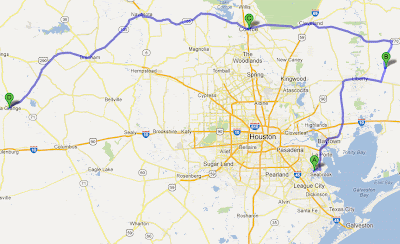
I drove this morning to the Armand Bayou Nature Center [map; point A in the map below] outside Clear Lake City, where I went to high school. Back then I used to cut through the woods to get from the school to my subdivision; now that's now possible, because fences have been put up preventing anyone from crossing into the woods. All you can access is the nature preserve, and you have to wait until it opens at 9:00 a.m. But finally I got in, and I took pictures of the other main thing I wanted to see: the pasture.
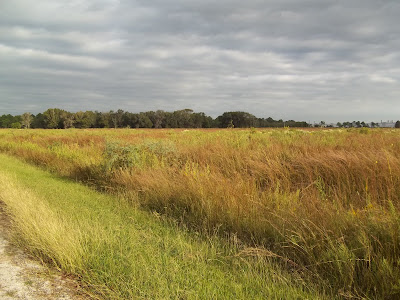
They call it a "prairie;" the fact is that it's a pasture that hasn't fed cattle for 50 or 60 years. The old guy who owned the ranch refused to sell it to real estate developers, and his heirs donated it to a nature conservancy, so there's a couple of square miles of woods and bayou and "prairie" that is beautifully undeveloped.
I spent a lot of time in these woods and fields when I was a teenager. This was my place of retreat. If not this exact pasture, then very near it.
After that I drove north and found myself near the hamlet of Daisetta (point B below), site of a famous sinkhole which opened up suddenly in 2008. I found a pond which I thought was in the right place, but it wasn't very large -- smaller than I expected it to be. I was too shy to ask anyone. This is pretty much how I've handled the whole trip: I go someplace and see something and am too shy to ask anyone about what I'm seeing, or whether I'm even looking at what I think I'm looking at. (Oil drilling: horizontal or vertical? Fracking or standard procedure? I couldn't tell.)
After that I drove west across the state, trying to avoid Houston, which I did by going through Cleveland, Conroe and Navasota. I'm spending my last night in Texas in La Grange, which is near Austin. I'm going home tomorrow, four days early.

They call it a "prairie;" the fact is that it's a pasture that hasn't fed cattle for 50 or 60 years. The old guy who owned the ranch refused to sell it to real estate developers, and his heirs donated it to a nature conservancy, so there's a couple of square miles of woods and bayou and "prairie" that is beautifully undeveloped.
I spent a lot of time in these woods and fields when I was a teenager. This was my place of retreat. If not this exact pasture, then very near it.
After that I drove north and found myself near the hamlet of Daisetta (point B below), site of a famous sinkhole which opened up suddenly in 2008. I found a pond which I thought was in the right place, but it wasn't very large -- smaller than I expected it to be. I was too shy to ask anyone. This is pretty much how I've handled the whole trip: I go someplace and see something and am too shy to ask anyone about what I'm seeing, or whether I'm even looking at what I think I'm looking at. (Oil drilling: horizontal or vertical? Fracking or standard procedure? I couldn't tell.)
After that I drove west across the state, trying to avoid Houston, which I did by going through Cleveland, Conroe and Navasota. I'm spending my last night in Texas in La Grange, which is near Austin. I'm going home tomorrow, four days early.

Wednesday, October 17, 2012
Texas Road Trip, Day 3: Enough of fracking
Woke up this morning in San Antonio. Weather was utterly dreary: thick fog and drizzle, just a complete mess. I found my way to a cafe with wi-fi and camped out for about an hour and a half, until morning rush hour was over and I had a plan for the day.
I had a choice of going west to Carrizo Springs to see more drilling, trucks, pipelines, RVs camped in a pasture, etc. etc. -- but aside from a slight change in the landscape (it would have been drier and more desert-y), I didn't expect to see much that I hadn't seen during the first two days. I realized there was only one thing I really wanted to see in the state of Texas: the Rothko Chapel in Houston which, despite having lived in Texas for ten years, I had never seen. So I drove to Houston.
As I drove west, the murk cleared up and the day became hot and cloudy/sunny -- pretty much a typical summer day. That it is mid-October doesn't matter a bit. The clouds were light and fluffy and the air was hot and humid. OK, it was only 90 degrees, not 103 like it was during the summer.
In Columbus, I stopped and drove around a little, because that was a spot I drove through on the way from Houston to Austin back in the 70s. I found a couple of miles of the old highway that runs through and out of the town before it meets the new freeway that has erased the rest of the old road.
Houston is pretty amazing. Imagine Las Vegas in the way it over-does everything possible. Now multiply its size by about 10. That's Houston, with 12-lane freeways decorated with gigantic stars, and futuristic skyscrapers not just downtown but in concentrations of office buildings at various places along the roads leading into town. I was listening to a sports radio station and heard consecutive commercials as follows: 1) An anti-Obama commercial sponsored by the gun lobby, saying if Obama was re-elected he would take away not only "our" Second Amendment rights, but also threaten the First Amendment; 2) A commercial by the natural gas lobby saying how wonderful it was; and 3) A commercial by a local gun dealer that was so over-the-top it sounded like it was produced by the Firesign Theater. That was on a sports station, which was the only one I could listen to without encountering Rush Limbaugh, Sean Hannity or some other right-wing beanbag.
I won't even mention how heavy the traffic was, despite all the multi-lane freeways. In fact, they aren't happy with the existing Interstate Highway System; they are busy opening parallel freeways that are toll roads. There's one that bypasses Austin, another that partially circles Houston.
After all that, the Rothko Chapel was quite a relief.

Rothko Chapel
Then I found a cheap motel and settled in to watch baseball. We're in a rain delay.
I had a choice of going west to Carrizo Springs to see more drilling, trucks, pipelines, RVs camped in a pasture, etc. etc. -- but aside from a slight change in the landscape (it would have been drier and more desert-y), I didn't expect to see much that I hadn't seen during the first two days. I realized there was only one thing I really wanted to see in the state of Texas: the Rothko Chapel in Houston which, despite having lived in Texas for ten years, I had never seen. So I drove to Houston.
As I drove west, the murk cleared up and the day became hot and cloudy/sunny -- pretty much a typical summer day. That it is mid-October doesn't matter a bit. The clouds were light and fluffy and the air was hot and humid. OK, it was only 90 degrees, not 103 like it was during the summer.
In Columbus, I stopped and drove around a little, because that was a spot I drove through on the way from Houston to Austin back in the 70s. I found a couple of miles of the old highway that runs through and out of the town before it meets the new freeway that has erased the rest of the old road.
Houston is pretty amazing. Imagine Las Vegas in the way it over-does everything possible. Now multiply its size by about 10. That's Houston, with 12-lane freeways decorated with gigantic stars, and futuristic skyscrapers not just downtown but in concentrations of office buildings at various places along the roads leading into town. I was listening to a sports radio station and heard consecutive commercials as follows: 1) An anti-Obama commercial sponsored by the gun lobby, saying if Obama was re-elected he would take away not only "our" Second Amendment rights, but also threaten the First Amendment; 2) A commercial by the natural gas lobby saying how wonderful it was; and 3) A commercial by a local gun dealer that was so over-the-top it sounded like it was produced by the Firesign Theater. That was on a sports station, which was the only one I could listen to without encountering Rush Limbaugh, Sean Hannity or some other right-wing beanbag.
I won't even mention how heavy the traffic was, despite all the multi-lane freeways. In fact, they aren't happy with the existing Interstate Highway System; they are busy opening parallel freeways that are toll roads. There's one that bypasses Austin, another that partially circles Houston.
After all that, the Rothko Chapel was quite a relief.

Rothko Chapel
Then I found a cheap motel and settled in to watch baseball. We're in a rain delay.
Tuesday, October 16, 2012
Texas Road Trip, Day 2 -- near Kenedy (sic)
I took a nice walk on the beach this morning in Port Aransas. Without really planning to, I walked down the beach all the way to the ship channel. There, in about 1971 when I was barely a teenager, I walked with my father just after dawn to see a large ship coming out of the channel. And diving playfully, just in front of its bow, were two or three dolphins. This was a magical moment, one of those times when the universe arranges itself before you in an unexpectedly beautiful way. And one of the best memories I have of a nice moment with my dad. This morning I didn't expect the experience to repeat itself, but a large ship was coming in through the channel, and at first there were no dolphins -- and then there they were, doing the same trick, dving in graceful arcs just in front of the ship's huge bow. I guess it's a dolphin thing.
After I walked back to the hotel, it began to rain. For over an hour while I had breakfast and conducted a phone interview, rain poured down. When I finally checked out and went down to my car, I found I had left the windows open. I had to take a bunch of tourist giveaway newspapers from the hotel's lobby to sit on until they mopped up the water.
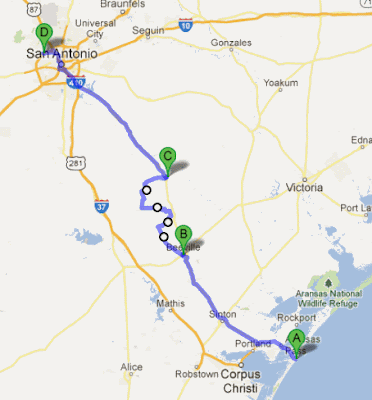
I drove northwest up US 181 all the way to San Antonio, but around the towns of Kenedy (sic) and Karnes City I took loads of side roads just to the west, and I saw tons of oil wells in every stage -- old ones that were capped, new ones being drilled, and many in every stage in between.
Here's what the pad looks like with the well head when they finish drilling it and connecting it to a pipeline:

Much of the area I drove through, west of the highway between Beeville and Karnes City, was still ranch country, beautifully oak-covered. Other spots were untended brush. But in other places there were large industrial installations. In one spot there was a big area the size of about 20 football fields that was entirely stripped, taken up with gigantic equipment and a few large buildings; a sign identified it as an oil pumping station. That's one thing that demonstrated the immediate area had been an oil field for many years.
Then other thing was the presence of many pipelines. They'll all buried, but of course where the road crossed them they're clearly marked. I saw a lot of pipelines, both natural gas (blue signs) and oil (orange signs). And I also crossed the route of a new pipeline under construction:

In Karnes City, I stopped for a while at a major intersection. I saw probably four times as many huge trucks as I did yesterday in Cuero. And at the gas station-store, there were lots of oil field workers, dressed in jumpsuits or t-shirts emblazoned with the names of their employers. These included vans full of red-suited Halliburton workers. Of course Halliburton was an oil field services company long before it was a general services provider in Iraq under the Bush administration.
Back on the main road, I passed several brand-new hotels, all with large pickup trucks in the parking lots. And I also passed several places where large new RVs had parked. All this is housing for oil field workers.

Sorry for the tilt.
Finally I drove up to San Antonio, where I checked into a cheap hotel (and if you want a fairly dependable cheap hotel, go to a Super 8) in time to watch the second Presidential debate.
After I walked back to the hotel, it began to rain. For over an hour while I had breakfast and conducted a phone interview, rain poured down. When I finally checked out and went down to my car, I found I had left the windows open. I had to take a bunch of tourist giveaway newspapers from the hotel's lobby to sit on until they mopped up the water.
I drove northwest up US 181 all the way to San Antonio, but around the towns of Kenedy (sic) and Karnes City I took loads of side roads just to the west, and I saw tons of oil wells in every stage -- old ones that were capped, new ones being drilled, and many in every stage in between.
Here's what the pad looks like with the well head when they finish drilling it and connecting it to a pipeline:

Much of the area I drove through, west of the highway between Beeville and Karnes City, was still ranch country, beautifully oak-covered. Other spots were untended brush. But in other places there were large industrial installations. In one spot there was a big area the size of about 20 football fields that was entirely stripped, taken up with gigantic equipment and a few large buildings; a sign identified it as an oil pumping station. That's one thing that demonstrated the immediate area had been an oil field for many years.
Then other thing was the presence of many pipelines. They'll all buried, but of course where the road crossed them they're clearly marked. I saw a lot of pipelines, both natural gas (blue signs) and oil (orange signs). And I also crossed the route of a new pipeline under construction:

In Karnes City, I stopped for a while at a major intersection. I saw probably four times as many huge trucks as I did yesterday in Cuero. And at the gas station-store, there were lots of oil field workers, dressed in jumpsuits or t-shirts emblazoned with the names of their employers. These included vans full of red-suited Halliburton workers. Of course Halliburton was an oil field services company long before it was a general services provider in Iraq under the Bush administration.
Back on the main road, I passed several brand-new hotels, all with large pickup trucks in the parking lots. And I also passed several places where large new RVs had parked. All this is housing for oil field workers.

Sorry for the tilt.
Finally I drove up to San Antonio, where I checked into a cheap hotel (and if you want a fairly dependable cheap hotel, go to a Super 8) in time to watch the second Presidential debate.

Monday, October 15, 2012
Texas Road Trip, Day 1: First pass through fracking zone
I left Austin late this morning. I couldn't resist just a little pass through town, but I limited myself to a few streets in South Austin. Along Lamar and South First I saw a lot of self-consciously quirky shops and bars, one of them trying way too hard with murals and a big statue of a mascot of a large-breasted woman, the shop itself emblazoned with the legend: "Since 1997." That 15-year history failed to impress me, but as I watched, I saw people taking their pictures with the statue of the mascot, so it must be a landmark. Because I'm a terrible journalist, I didn't take a picture.
In fact, I was terrible, just terrible, at taking pictures all day. Here's the best one:
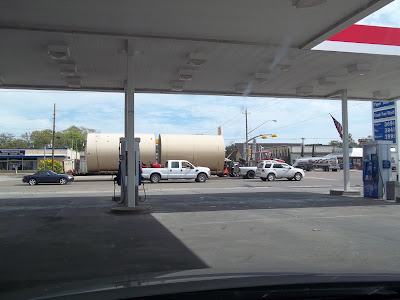
I was in a town called Cuero, a small town that is in the middle of the eastern side of the Eagle Ford Shale. The New York Times last month said it was overrun with huge trucks, and there certainly were a lot. So there you go, a truck. I sat at the main intersection of town for half an hour grokking the trucks.
Before that I managed to find some good sites where fracking actually seemed to be going on. Or drilling of some kind. It's not like they put up a big sign that says Fracking Here! Basically you have a temporary, portable drilling rig, four or five stories high, surrounded by trucks and equipment, in the middle of a two-or-three acre patch of denuded pasture.
The setting was what I found most interesting. I drove through beautiful countryside between Gonzales and Cuero, the pastures mostly green because it rained a lot here a few weeks ago. When they pick a spot, they strip off all vegetation over a few acres, forming a perfectly rectangular bare patch. Aside from the road they build into the site, they seem to leave the rest of the surroundings alone. (Supposedly the industry has learned from the public relations disaster that was their exploitation of another area in Texas, the Barnett Shale zone.)
I swung through Victoria, which I visited once many years ago when I found it a nice little city. It's now a hollowed out, sprawling mess. There's a historic district in the center that's like a ghost town; on the outskirts are 8-lane-wide boulevards and shopping centers.
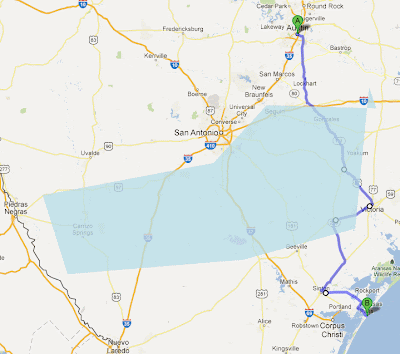
Then I drove south toward the coast. It wasn't that I wanted to go to the coast so much that you can't find a hotel room in the fracking zone; they're all occupied by workers. So I had to drive 70 miles south, and decided I may as well go to Port Aransas, a beach town reached by a short ferry ride.
The blue area in the map is approximately the Eagle Ford shale. I drove through the eastern edge of it.
In fact, I was terrible, just terrible, at taking pictures all day. Here's the best one:

I was in a town called Cuero, a small town that is in the middle of the eastern side of the Eagle Ford Shale. The New York Times last month said it was overrun with huge trucks, and there certainly were a lot. So there you go, a truck. I sat at the main intersection of town for half an hour grokking the trucks.
Before that I managed to find some good sites where fracking actually seemed to be going on. Or drilling of some kind. It's not like they put up a big sign that says Fracking Here! Basically you have a temporary, portable drilling rig, four or five stories high, surrounded by trucks and equipment, in the middle of a two-or-three acre patch of denuded pasture.
The setting was what I found most interesting. I drove through beautiful countryside between Gonzales and Cuero, the pastures mostly green because it rained a lot here a few weeks ago. When they pick a spot, they strip off all vegetation over a few acres, forming a perfectly rectangular bare patch. Aside from the road they build into the site, they seem to leave the rest of the surroundings alone. (Supposedly the industry has learned from the public relations disaster that was their exploitation of another area in Texas, the Barnett Shale zone.)
I swung through Victoria, which I visited once many years ago when I found it a nice little city. It's now a hollowed out, sprawling mess. There's a historic district in the center that's like a ghost town; on the outskirts are 8-lane-wide boulevards and shopping centers.
Then I drove south toward the coast. It wasn't that I wanted to go to the coast so much that you can't find a hotel room in the fracking zone; they're all occupied by workers. So I had to drive 70 miles south, and decided I may as well go to Port Aransas, a beach town reached by a short ferry ride.
The blue area in the map is approximately the Eagle Ford shale. I drove through the eastern edge of it.

Sunday, October 14, 2012
Texas Road Trip, Day 0: Flying to Austin
I'm in Texas on vacation, and to research something for the novel I'm working on. When I tell people I've come to Texas to research fracking, they can't believe it. I overheard Cris saying to a friend, "First he went to Minnesota to see what it was like in a blizzard, and then he went to the desert to find survivalists, and now he's going to Texas to get himself in trouble with oil roughnecks."
It's true that all those trips were research for this book. But I took out the part about the survivalists. And the fracking stuff is really for a story-within-a-story. However, I'm also thinking of setting my next book in this milieu, so this is both research for my current project and for the possible next one.
I'm in a hotel near the Austin airport. I went to university in Austin, many years ago, and at the time I had a frantic love for the city. Then I graduated and got a little sick of it, and moved to San Francisco. I've only been back twice before this. Once, in 1981, was only two years after I'd left, and it was still very much the same place. The next time was in 2001, and it was very much not the same place. In the intervening 20 years, the tech industry had come to town, and Republicans were in the ascendancy. There were huge new developments all over, and a freeway had replaced the sweet two-lane state highway I used to take from Houston to Austin, a road that meant so much to me I wrote a song about it. In 2001 I actually drove 100 miles to the town of Columbus and attempted to drive the fondly-remembered highway, but the freeway had erased it almost entirely. Now -- that is, in 2001 -- it was just another drive through countryside.
Now it's almost 12 years after that. I have no hopes of a nostalgic reunion with any of my favorite places, going on 37 years since I left town 9 months after graduating. So much money and development has come to town that it would be like going to Las Vegas and attempting to find old Rat Pack hangouts. Of course, the university itself is still there, and many of its buildings are even the same. (Of course, when I attended in the mid-70s, it was already full of newer buildings which probably shocked anyone who had attended even 10 years earlier.) But even in 2001 almost none of the funky houses and buildings I'd lived in still existed; they'd been torn down and replaced with condos and large apartment buildings. So I'm not going to spend much time trying to connect with my youth.
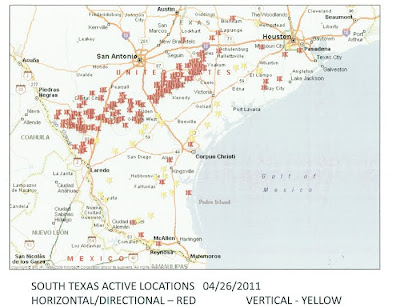
Instead, I'm going to drive south, toward the Eagle Ford Shale zone, and try to find some fracking. The illustration below shows the zone, marked by red pins, spreading across south Texas.
It's true that all those trips were research for this book. But I took out the part about the survivalists. And the fracking stuff is really for a story-within-a-story. However, I'm also thinking of setting my next book in this milieu, so this is both research for my current project and for the possible next one.
I'm in a hotel near the Austin airport. I went to university in Austin, many years ago, and at the time I had a frantic love for the city. Then I graduated and got a little sick of it, and moved to San Francisco. I've only been back twice before this. Once, in 1981, was only two years after I'd left, and it was still very much the same place. The next time was in 2001, and it was very much not the same place. In the intervening 20 years, the tech industry had come to town, and Republicans were in the ascendancy. There were huge new developments all over, and a freeway had replaced the sweet two-lane state highway I used to take from Houston to Austin, a road that meant so much to me I wrote a song about it. In 2001 I actually drove 100 miles to the town of Columbus and attempted to drive the fondly-remembered highway, but the freeway had erased it almost entirely. Now -- that is, in 2001 -- it was just another drive through countryside.
Now it's almost 12 years after that. I have no hopes of a nostalgic reunion with any of my favorite places, going on 37 years since I left town 9 months after graduating. So much money and development has come to town that it would be like going to Las Vegas and attempting to find old Rat Pack hangouts. Of course, the university itself is still there, and many of its buildings are even the same. (Of course, when I attended in the mid-70s, it was already full of newer buildings which probably shocked anyone who had attended even 10 years earlier.) But even in 2001 almost none of the funky houses and buildings I'd lived in still existed; they'd been torn down and replaced with condos and large apartment buildings. So I'm not going to spend much time trying to connect with my youth.
Instead, I'm going to drive south, toward the Eagle Ford Shale zone, and try to find some fracking. The illustration below shows the zone, marked by red pins, spreading across south Texas.

Subscribe to:
Posts (Atom)


